Live dealer roulette at UK-licensed casinos
Best Live Roulette Online: UK Sites Tested and Ranked for August 2026
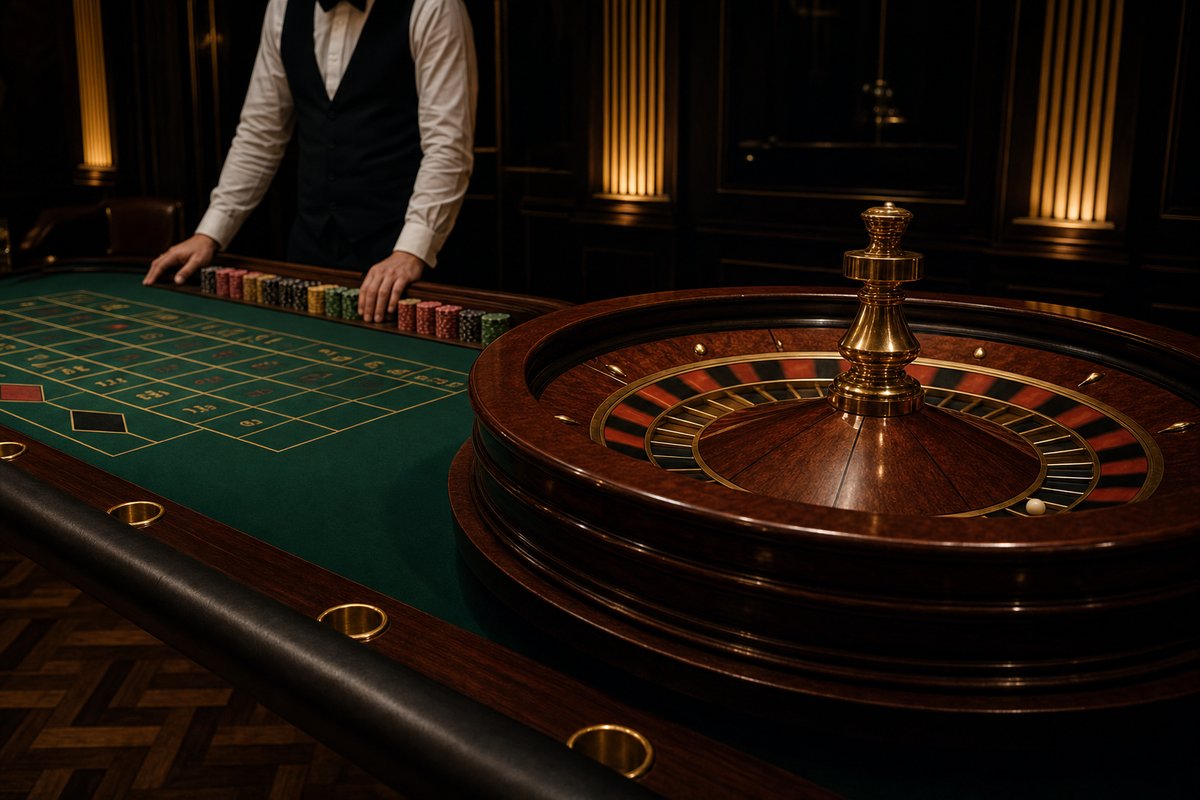
You can play live roulette online in Britain at any casino the Gambling Commission licenses, and the difference between the good ones is not the wheel itself. It is how deep the roulette catalogue behind it runs, and how many genuinely different wheels sit in that catalogue.
What playing live roulette online actually involves
A croupier stands at a real wheel in a broadcast studio. Several cameras cover the wheel, the layout and the croupier, and the feed reaches you with a second or so of delay. Your bets go on a digital layout drawn over the video, and when the betting window closes the ball is already in the air. Optical recognition reads the winning pocket and settles every seat at that table at once, which is why a hundred players can share one wheel without waiting for each other.
That architecture explains most of what feels different about live roulette online compared with the RNG version. The pace is set by a person, not by your clicking, so a round takes somewhere between forty seconds and a minute at a standard table. You cannot pause it. You cannot speed it up. If you are late to the layout, you sit the round out and watch.
The arithmetic, though, is not different at all. A single-zero live wheel returns 97.30% and keeps 2.70%, exactly as its software counterpart does, because the edge is a property of thirty-seven pockets paying thirty-six to one. Nothing about a human arm changes that. What the live format buys you is visibility and atmosphere; what it costs you is control of the clock.
The best live roulette online casinos in Britain
Every operator below holds a Gambling Commission licence and runs live roulette to players in Great Britain. The order is the one the homepage carries, and it comes from the two criteria that have been counted rather than asserted: how deep each roulette catalogue runs, and how many distinct wheels it holds. The honesty of the betting-limit ladder, how an operator behaves at withdrawal, the depth of its safer-gambling tools and whether the felt works one-handed on a phone all sit in the published rubric, and none of them is in the order yet, which is why no score appears beside any name.
| # | Casino | Roulette games counted 29 July 2026 | Wheel variants | Visit |
|---|---|---|---|---|
| 1 |

|
Roulette games 89+ | Wheel variants American · Auto · European · French · Immersive · Instant · Lightning · Speed |
Visit site
18+ · T&Cs apply · begambleaware.org |
| 2 |

|
Roulette games 58+ | Wheel variants American · European · First Person · Lightning |
Visit site
18+ · T&Cs apply · begambleaware.org |
| 3 |

|
Roulette games 35+ | Wheel variants American · Auto · European · French · Immersive · Lightning · Speed |
Visit site
18+ · T&Cs apply · begambleaware.org |
| 4 |

|
Roulette games 39+ | Wheel variants American · Auto · Double Ball · First Person · Lightning · Speed |
Visit site
18+ · T&Cs apply · begambleaware.org |
| 5 |

|
Roulette games 51+ | Wheel variants American · Immersive · Lightning · Speed |
Visit site
18+ · T&Cs apply · begambleaware.org |
| 6 |

|
Roulette games 35+ | Wheel variants Auto · Immersive · Instant · Lightning · Speed |
Visit site
18+ · T&Cs apply · begambleaware.org |
| 7 |

|
Roulette games 37+ | Wheel variants American · Immersive · Instant · Lightning |
Visit site
18+ · T&Cs apply · begambleaware.org |
| 8 |

|
Roulette games 22+ | Wheel variants Auto · Instant · Lightning · Speed |
Visit site
18+ · T&Cs apply · begambleaware.org |
| 9 |

|
Roulette games 16+ | Wheel variants European · French |
Visit site
18+ · T&Cs apply · begambleaware.org |
| 10 |

|
Roulette games 7+ | Wheel variants Auto |
Visit site
18+ · T&Cs apply · begambleaware.org |
The counts and variants in the table were taken from each casino's own lobby rather than copied from a comparison page, and each one is a floor: it is what was visible on the day, so a casino may carry more and will not carry fewer. The count covers every distinct roulette title in a catalogue, live-dealer and RNG together, since most lobbies list the two side by side and several of these operators publish them on a single page. It measures roulette range, then, rather than a live-table headcount. What the table deliberately still does not show is how many tables are dealing right now. A lobby with eleven single-zero tables on a Tuesday afternoon may have four on a Sunday night, so any number printed here would be wrong by the time you read it, and no amount of counting fixes that.
Scores are still absent for a different reason: two of the six weighted criteria have been measured and four have not, so a single figure per casino would imply a completeness that does not exist yet. The rating method publishes the weighting regardless, and the full ranking of UK online roulette casinos carries the same figures with the non-live variants included.
Live roulette sites UK players can legally use
Legality is the shortest part of this page and the one worth getting right first. To offer roulette to someone in Great Britain, an operator needs a remote licence from the Gambling Commission. That licence is what makes complaints escalable, funds held separately, and self-exclusion enforceable. The licence status of any site is checkable in one minute against the Commission public register, and a site that does not appear on it has no obligation to you that anyone can compel.
Three consequences follow that specifically shape how the live roulette sites UK players reach actually behave. Identity and age verification must be completed before you deposit or play, not at the point you try to withdraw. Credit cards are unavailable, having been banned for gambling in April 2020. And every licensee is wired into GAMSTOP, so one self-exclusion covers the whole licensed market at once rather than one brand at a time.
The register entry names the licensee company, not always the brand on the website. One licensee frequently operates several casinos, so search the company name printed in the site footer rather than the trading name over the door.
The live wheels you will meet in a UK lobby
Live studios have spent a decade differentiating a game whose rules cannot change, which has produced a genuinely useful spread of tables rather than one wheel repeated. Knowing which is which saves you from paying for a format you did not want.
Standard European. One zero, thirty-seven pockets, 2.70% edge. The default and the correct starting point. French. The same wheel with La Partage, returning half your stake on red, black, odd, even, high or low when zero lands. That is 1.35% on those bets, the best number in the building, and it is quietly the most underused table on most floors. American. Thirty-eight pockets and 5.26%. There is no argument for it; our wheel comparison does the arithmetic in full.
Lightning and its imitators. One to five numbers per round are struck for a 50x to 500x multiplier, funded by cutting the straight-up payout to 29 to 1. Evolution publishes 97.30% RTP on the outside bets, matching the plain wheel, and 97.10% on the straight-ups, so the shape of the outcomes changes and, on the numbers themselves, so does the cost. Auto-roulette. No croupier, an air-driven wheel, rounds inside half a minute and the lowest minimums on the floor. Cheap and fast, which is a combination worth watching in yourself. Immersive. Extra cameras and a slow-motion replay of the ball dropping. Double Ball. Two balls, adjusted payouts. Dual Play. A camera on a real casino floor, shared with the players standing at the table. Salon Privé and high-limit rooms. A private wheel where you set the pace, at a minimum that reflects it.
Which studio is behind the table, and why the lobby hides it
Almost no casino runs its own live roulette. The tables are supplied by a handful of studios, Evolution the largest among them, with Playtech and Pragmatic Play operating their own live floors. The casino licenses a feed and dresses the lobby around it.
This matters more than the branding suggests, because the studio decides what is available to you. Whether a French table with La Partage exists at all, how far the limit ladder stretches at either end, which formats are in the catalogue: those are studio decisions, not casino ones. A site cannot offer you a wheel its supplier does not run.
It also explains a pattern you will notice in the table above. Two casinos drawing on the same studio often present near-identical floors, so the brand over the door tells you very little about what you can actually sit at. That is precisely why the columns count games and wheel variants rather than reputation: catalogue depth is the part that differs once you look past the lobby art, and it is the part a player can verify.
Finding out which studio you are on takes a moment: the supplier is normally named in the table's own rules panel, and often on the lobby tile before you even open it. The practical move is then to search the lobby for the format you want rather than the brand you recognise. If French roulette is what you are after, its absence is a supplier limitation you cannot negotiate around, and a different casino on the same feed will not have it either.
Playing on a phone, where the mistakes are
Most British live roulette is played on a phone, and the felt is the part that suffers. A layout designed for a desktop and shrunk to a handset puts the single numbers at a few millimetres across, which is where mis-taps happen and where they cost you.
Two features separate a usable mobile table from a frustrating one. A racetrack lets you place neighbour bets and call bets by section rather than by hunting individual numbers, and saved bet layouts let you repeat a spread without rebuilding it inside a closing betting window. Without either, a phone player ends up confined to the outside bets by the interface rather than by choice.
Table interface and mobile play carry 8% of the published weighting, and that criterion is one of the four with no per-operator figure yet, so it is not applied to the order above. It is still worth a minute of your own testing: open a table, place one minimum bet on an inside number in portrait, and you will know immediately whether the felt was built for the screen you are holding.
What separates the best live roulette sites from the rest
The wheel is a commodity. Four things are not, and all four are visible before you deposit if you know to look. The live roulette sites UK regulars stay with tend to win on these rather than on anything advertised.
Table depth at your hour. Open the lobby at the time you actually play, not at the time you are researching. A floor with two single-zero tables on a Saturday night is a floor that will push you toward American or toward slots. The limit ladder. Look for a continuous climb from small stakes to the level you want, on single-zero tables. A site with penny auto-roulette and then nothing until the high-limit room has a hole exactly where most players sit.
Stream behaviour under load. Peak-hour degradation shows up as a dropped resolution or a stalled betting window, and it costs you rounds. Withdrawal behaviour. The moment that separates operators is not the welcome offer, it is the first time you ask for your money back. Verification completed at registration, a stated processing window, and no re-verification demanded at cash-out is the pattern you want.
Notice what is absent from that list. Bonus size is not weighted at all, and that is deliberate: roulette contributes between nothing and ten per cent toward wagering requirements at most casinos, and some exclude live tables from bonus play altogether. A generous offer you cannot use at the wheel is not an offer to a roulette player.
Where live roulette online costs more than players expect
Two costs are easy to miss, and neither is a fee.
The first is round rate. Edge is charged per pound staked, not per hour, so anything that raises the number of rounds you play raises your expected cost proportionally. Auto-roulette at twenty-five seconds a round is close to double the turnover of a standard live table in the same hour, at the same edge. That is not a trick; it is simply what happens when you multiply. Flat-betting five pounds through a hundred rounds is five hundred pounds of turnover and an expected loss of thirteen pounds fifty on a single-zero wheel.
The second is the American table you did not notice. Studios name tables after their brands and their sponsors, so the pocket count is not always in the title. Doubling the edge from 2.70% to 5.26% is the single most expensive unforced error available at a roulette table, and it is one glance at the wheel to avoid.
No betting pattern changes either figure. Progressions redistribute your losses into a different shape, making them smaller and more frequent while adding a rare large one. Our strategy simulator runs Martingale, D'Alembert and Fibonacci against a fair wheel and charts the average net result, which is the only view that answers the question honestly.
Getting seated: verification, deposits and the first session
Register, verify, then deposit, in that order and preferably before the evening you intend to play. Verification usually means a photo of an identity document and sometimes a proof of address; it is a licence condition rather than an obstacle the operator invented, and getting it done early is what prevents the classic frustration of a completed win meeting an unfinished account.
Set a deposit limit at the same time. It takes a moment while you are calm, applies before you need it, and takes effect immediately when tightened. Then open the live lobby, find a European or French table with a betting window open, and watch one round settle without betting on it. One round tells you the pace, the limits and whether the stream holds.
If you want to learn the layout before any of that, the playable wheel here runs in the browser with no account and no money involved, and how to play roulette covers the bets in order.
Lightning tables move the payout, not the edge
A large share of the live lobby is now multiplier roulette rather than the plain game. Evolution's Lightning Roulette is the one most players meet first: after betting closes, one to five numbers are struck at random and carry a multiplier between 50x and 500x for that round alone. Playtech's Quantum Roulette does much the same thing with its own presentation, and there are several more behind them.
The part worth reading carefully is where the multiplier money comes from. On a Lightning table a straight-up number pays 29 to 1 rather than the standard 35 to 1, every round, whether or not your number was struck. That reduction is what funds the multipliers, and it does not quite fund them in full. Evolution's paytable puts the return on straight-up bets at 97.10%, against 97.30% on a plain single-zero table, so the house edge on those bets is 2.90% rather than 2.70%. The difference is small and it is real, and it runs in the casino's direction.
What you buy for it is a different shape of outcome rather than a better one. Far more rounds return nothing, because the great majority of straight-up wins now pay 29 instead of 35, and occasionally one round returns fifty to five hundred times the stake. If that trade appeals, it is available at a stated price. It is not free, whatever the presentation suggests.
Every other bet on the table is paid by the standard rules and keeps the usual 97.30%, which makes these tables a strange fit for anyone betting red and black. The multipliers attach only to straight-up numbers; splits, corners, streets and lines never qualify for one. If you play live roulette online mainly on even-money bets, a multiplier table gives you the slower pace and the light show and none of the upside.
When the stream drops mid-round
This happens, usually on mobile data, and it is worth knowing in advance rather than during. A bet that was confirmed before the betting window closed stands. The round continues without you, the result is settled against your account by the operator's server rather than by your screen, and any winnings are there when you reconnect. Losing the video does not void the bet and does not refund it.
Reconnect and check the round history before doing anything else, because the interface will not always tell you what you missed. If the money does not match the history, that is a support ticket with a timestamp attached, and every UK-licensed operator keeps the round record on its side. The stream is a camera feed, not the game.
One related thing to budget for: live tables carry higher minimums than RNG ones, because a dealer, a studio and a camera crew have to be paid for out of the table's turnover. A £0.10 RNG table and a £1 or £2 live table can sit side by side in the same lobby running the same game at the same 2.70%. The difference in the minimum is the cost of the person spinning the wheel, and on a slower table you will also play far fewer rounds an hour for it.
Playing within limits
Live roulette online is designed to be pleasant company for an evening, and the format is unusually good at making an hour disappear. Decide the amount before you sit down, treat it as the price of the evening rather than as a stake to recover, and stop at that number whether it is winning or losing.
If it stops being entertainment, the tools are immediate and free. Deposit limits and reality checks are in your account settings. GAMSTOP excludes you from every licensed British operator at once. GamCare runs the National Gambling Helpline on 0808 8020 133, around the clock and at no charge, and BeGambleAware publishes self-assessment tools and advice for family. Our responsible gambling page lists all of it in one place.
Where the wheel actually is: the studios behind the lobby
Playtech's live studio in Riga opened in 2017 on the site of the city's sixteenth-century fortified walls, covering 8,500 square metres, and was the largest facility of its kind anywhere at the time. Evolution runs its own Riga studio a short distance away: more than 2,000 square metres and over a hundred tables, one of three production hubs the company names in its own reporting, alongside sites in Malta and Tbilisi. Pragmatic Play built its live operation from scratch in Bucharest, opened in 2019 with room for more than forty tables running at once. Playtech's building went further than a set of tables. It included its own control and monitoring centre and what industry press at the time called a dealer campus, space built for training and rotating the staff who work the wheels rather than simply housing them. None of the casinos in the ranking above employs a dealer directly. Each one licenses a feed from one of these three studios, sometimes more than one, and the studio decides which tables exist to be licensed in the first place.
How the spin becomes your on-screen result
The physical read is automated rather than typed in by anyone watching. Reflective infrared sensors positioned around the wheel work alongside high-frame-rate cameras, as many as fourteen of them on Evolution's Immersive tables, because standard video, shot at only twenty-five to thirty frames a second, blurs a spinning ball too badly for reliable optical tracking. The combined output of the sensor rig and the computer-vision layer is what confirms the winning pocket and pushes it to every connected screen at once. The croupier calls the number for the room's benefit. The result that settles your account comes from the hardware and software underneath, not from a person's word for it.
That layer is also what independent testing laboratories inspect. Gaming Laboratories International, which certifies RNG software for regulated markets worldwide, also runs remote and on-site evaluations of live-dealer setups specifically: the physical wheel, the sensor rig, the dealer's procedures and the accuracy of the translation from a real spin to a digital result. eCOGRA and iTech Labs offer the same live-specific testing under their own accreditation. That certificate belongs to the studio operating the table, not to any individual casino using its feed, which is one more reason two unrelated brands can show you an identical wheel down to the felt.
Speed Roulette is a different shortcut from Auto-Roulette
Auto-roulette, covered above, removes the dealer altogether: an air-driven wheel with no one presiding over it. Speed Roulette keeps a person on screen but changes what that person does. Evolution's version starts a new round every 25 seconds, with the person on screen working as a host rather than as the dealer running the game: they announce the spin and talk to players while an automatic mechanism spins the wheel and launches the ball. The ball leaves before the betting window closes rather than after it, so the sequence most players expect, bet, wait, watch it drop, becomes an overlap instead of three separate stages. Nothing about the wheel changes for the trouble. A single-zero Speed table still returns 97.30%. It simply delivers roughly fifty more of those rounds in an hour than a standard-paced table, which is exactly what the round-rate arithmetic further up this page predicts for your turnover.
The same staffing logic explains the spread between live formats generally. Auto-roulette and Speed Roulette use no dealer, or a host rather than a full one, and both sit near the cheap end of a live lobby's limit ladder. Salon Privé and other private-room tables give a dealer's full attention to a handful of players rather than to a public queue, and sit at the far end. Pace and price are moving together here for a reason: a table that occupies less staff time per round costs less to open at a low stake, and a table that occupies more costs more.
First Person tables are not live roulette at all
One more table in the lobby deserves a mention, because it looks exactly like the others and is not one of them. First Person Roulette uses the same interface, the same studio branding and the same 97.30% RTP as a live single-zero wheel, but there is no physical wheel behind it. The spin is rendered in 3D, and the result comes from a certified random number generator rather than a ball landing anywhere. Evolution built it deliberately to sit next to its live tables with an identical layout, and a lobby will often let you jump between the RNG and the live version of the same game in one click, which is exactly why the two get confused. The giveaway is the clock. A First Person table has no betting window to beat, because nobody is waiting on you, while every genuinely live table closes its window on a schedule a dealer or a host is running. If a table lets you sit and think for as long as you like, you are not looking at a wheel.
Multi-language tables follow the same studio logic in reverse. Evolution alone runs live roulette hosted in French, German, Spanish, Italian, Swedish, Russian, Japanese, Romanian, Turkish and Arabic, each on its own dedicated table rather than a subtitle bolted onto the English feed. A UK-facing casino can license the English table from a studio's schedule without touching the German or Japanese one running in the same building at the same time, which is one more reason two lobbies drawing on the same supplier can look identical while covering different parts of the day.
Frequently asked questions
What is live roulette online?
A real wheel in a broadcast studio, spun by a real croupier, streamed to you in HD while you place bets on a digital layout over the video. The outcome is decided by a physical ball in a physical pocket, read by optical recognition and pushed back to every seat at the table. Live roulette online is therefore the same game as a casino floor with the travel removed, not a computer simulation of one.
Is live roulette fairer than the RNG version?
Neither is unfair, and the house edge is usually identical. A single-zero wheel costs 2.70% whether the number comes from a ball or a certified random number generator. What differs is what you can verify with your own eyes: a live wheel is visibly physical, which some players find more trustworthy even though the arithmetic is unchanged.
How do I play live roulette online in the UK?
To play live roulette online in the UK, register with a Gambling Commission licensed casino, complete identity and age verification, deposit by debit card or bank transfer, then open the live casino lobby and pick a table showing an open betting window. Verification comes before you can deposit or play, so it is worth completing it before you intend to sit down rather than at the table.
Can I use a credit card to fund live roulette?
No. Credit cards have been banned for gambling in Great Britain since April 2020. Debit cards, bank transfer and most e-wallets remain available, though some e-wallet deposits are excluded from bonus offers. A site still offering a credit-card option to British players is a site to leave. The ban followed evidence that credit-based gambling correlated strongly with problem debt, which is also why the same rule now covers Apple Pay and Google Pay funded by a linked credit card.
What is the minimum stake at a live table?
Lower than most people expect. Auto-roulette and standard European tables commonly open at well under a pound per bet, which makes the outside bets accessible at very small stakes. Minimums rise with the table tier, and private or high-limit rooms start considerably higher. Every table displays its own limits before you take a seat.
Which live roulette variant has the best odds?
French roulette on a live table, where the La Partage rule returns half your stake on an even-money bet when the ball lands in zero. That halves the edge on those bets to 1.35%, or 98.65% RTP, the best figure on any roulette table anywhere. Standard European is next at 2.70%. Avoid American live tables, which run at 5.26%.
How does Lightning Roulette change the maths?
It redistributes, and it is not free. Evolution publishes two figures rather than one: 97.30% RTP on the outside bets, which matches a standard single-zero wheel, and 97.10% on straight-ups, where the 50x to 500x multipliers are funded by cutting the payout from 35 to 1 down to 29 to 1. Bet the outsides and the maths is unchanged. Bet the numbers and you are buying a longer tail of outcomes at a slightly higher cost.
What internet speed do I need?
Any connection that streams video comfortably will carry a live table. Stability matters far more than raw speed: a brief dropout during a betting window can cost you the round rather than the bet, because the wheel does not wait. On mobile data a live stream consumes roughly what video streaming does, which is worth knowing before a long session away from wi-fi.
What happens if my connection drops mid-spin?
Bets already confirmed by the server stand and are settled normally, so a dropout after you have committed does not void the round. Bets not yet confirmed when the window closed are simply not placed. When you reconnect, the result and the settlement are in your account history. Every licensed operator publishes its own disconnection policy in its terms.
Are the hot and cold numbers on the statistics panel useful?
No, and they are the most expensive thing on the screen. Every spin is independent of every spin before it. A number that has landed five times in an hour is exactly as likely on the next spin as one that has not appeared all day. The panel is engagement furniture; it contains no information about what comes next.
Can I count on a dealer or a wheel developing a bias?
Not at a regulated studio. Wheels are maintained and rotated, balls are changed, and the studios are audited precisely because a measurable bias would be a commercial problem for them. Dealer-signature theories require a repeatability that does not survive shift changes and equipment rotation. The historical cases of exploited bias all involved a single physical wheel run for years without maintenance, a setup no licensed live studio uses today.
Do the UK slot restrictions apply to live roulette?
The slot-specific ones do not. The autoplay ban and the statutory stake caps were written for online slots, and a live table sits outside both. Speed of play is the exception worth knowing: the Gambling Commission sets a 2.5 second minimum between slot cycles in RTS 14D, and since January 2025 a five second minimum for other casino games in RTS 14G, which does cover live roulette. A dealer-paced round runs far longer than five seconds, so the limit is met without anyone noticing it. Licensing, verification and self-exclusion apply in full either way.
What is a Dual Play table?
A table on a genuine land-based casino floor with a camera on it, shared between the players standing there and the players online. The wheel is the venue's own equipment and the pace is set by the room rather than by a studio schedule, which makes it slower and, for some players, considerably more atmospheric.
Should I tip the dealer?
It is entirely optional and no operator requires it. Most live interfaces include a tipping control because the croupiers are working people on a shift and some players prefer to acknowledge that. It buys no advantage of any kind, and it should be counted as spending rather than as staking.
Can I play live roulette if I am registered with GAMSTOP?
No. GAMSTOP self-exclusion blocks your access across every Gambling Commission licensed online operator, live tables included, for the period you selected. That is the scheme working as designed. Any site offering you access while you are registered is by definition operating outside the British licensing regime. The block covers the full six-month, one-year or five-year term you chose; no operator can end it early or override it manually, however the account was opened.
Are winnings from live roulette taxable in the UK?
Gambling winnings are not taxed as income for players in the United Kingdom. The duty is levied on the operator rather than on you, so a win at a licensed table arrives whole. This is general information about how the regime is structured, not tax advice for your circumstances. This has been the position since the 2001 reform shifted the duty from the punter to the operator’s gross profits, tightened further in 2014 when Point of Consumption rules extended that same duty to every operator serving UK customers regardless of where they are based.
Is a welcome bonus worth taking for live roulette?
Read the game weighting before you decide. Roulette contributes little or nothing toward wagering requirements at many casinos, and some exclude live tables from bonus play altogether, which means a bonus can lock funds you intended to use at the wheel. A smaller offer that counts is worth more than a large one that does not.