From your first chip to the payout
How to Play Roulette: The Rules, Bets and What Happens at the Table
A countdown appears in the corner of the screen. You have about fifteen seconds, the felt is covered in numbers you have not learned yet, and someone in the chat has just put four chips on a corner. Here is what all of it means, in the order you will actually meet it.
What is on the table
Two things: a wheel and a betting layout. The wheel holds 37 pockets on a European table, numbered 1 to 36 in alternating red and black plus a green zero. An American wheel adds a green double zero for 38, which is worth avoiding for reasons covered in the wheel comparison.
The betting layout is a grid of those same 36 numbers in three columns, with the zero at the top, and a border of larger boxes around it. Bets placed on the grid are called inside bets. Bets placed in the surrounding boxes are outside bets. That single distinction organises almost everything else.
Buying in and choosing a stake
Online you select a chip denomination rather than buying physical chips, then click the part of the layout you want to back. Clicking again adds another chip. Most interfaces put undo and clear buttons beside the chip tray, and both are worth locating before the first countdown rather than during it.

Check the table minimum and maximum first. These are typically set separately for inside and outside bets, so a table advertising a £1 minimum might want £1 on each outside bet but accept £1 spread across several inside numbers. The information panel states the exact rule. Read it once and you will not have a bet rejected mid-countdown.
The bets you can place
Inside bets
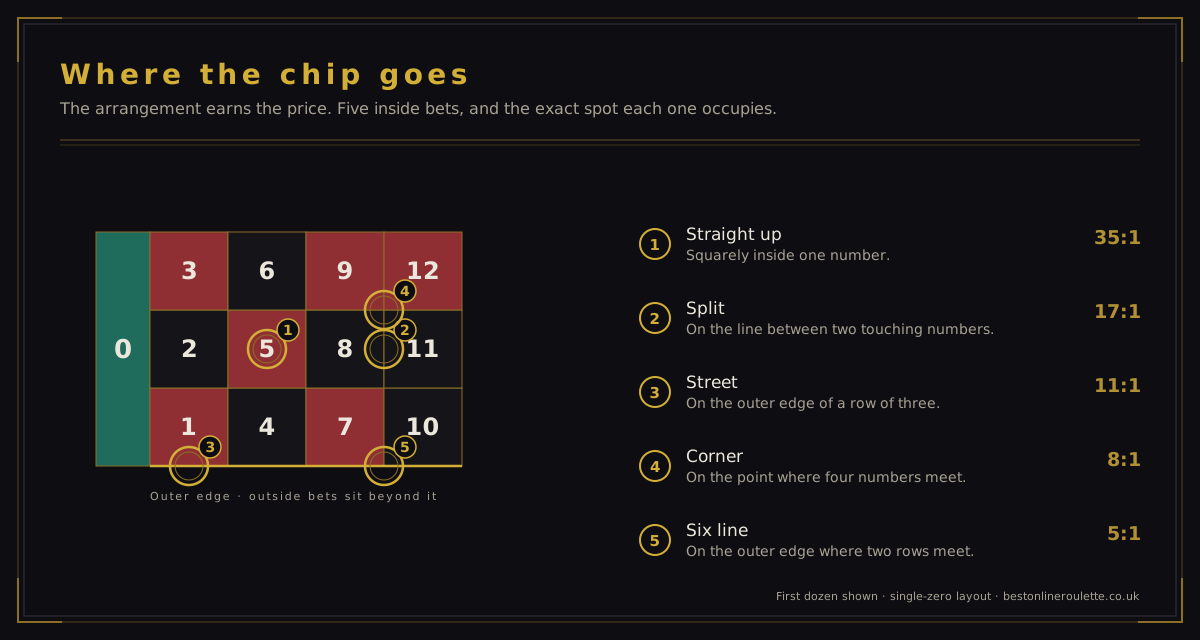
Placed directly on the numbers, covering one to six of them. A chip in the centre of a single number is a straight up. On the line between two numbers it is a split. At the end of a row it covers that row of three, called a street. On the intersection of four numbers it is a corner, and on the edge between two rows it is a six line.
Outside bets
Placed in the boxes around the grid. Red or black, odd or even, and 1 to 18 or 19 to 36 all pay even money and cover eighteen numbers. Dozens cover 1 to 12, 13 to 24 or 25 to 36, and columns cover one of the three vertical lines of the grid; both pay 2 to 1.
What each of these pays, how often it lands and why they all cost the same in the long run is set out in the odds and payouts guide, which is the one to read next if you want the arithmetic rather than the procedure.
How a round actually runs
The sequence is the same everywhere, and it is short.
- The betting window opens and a countdown starts, usually 12 to 20 seconds on a live table.
- You place chips. Multiple bets are fine and normal.
- The dealer announces no more bets and the layout locks. Anything not placed by then is not in play.
- The ball is released against the direction of the wheel and runs the track.
- It drops, bounces off the deflectors, and settles in a pocket.
- Losing chips are cleared, winning bets are paid, and the next window opens.
Payouts are stated as odds against your stake, not as a total. A winning £10 straight up returns £360: £350 in winnings plus your £10 back. On even-money bets the distinction barely registers, and on a 35 to 1 payout it is worth being clear about.
Every table displays the last several results, often with a tally of reds against blacks. It is there because it encourages betting, not because it predicts anything. Eight reds in a row leaves the chance of red on the ninth spin at 48.65%, exactly where it was before. The wheel has no memory, and the board exists to suggest otherwise.
Live tables versus RNG tables
An RNG table is software. There is no clock, no other players and no waiting, so you can sit with the layout and work out what a corner bet covers without a countdown running. Most licensed casinos let you play these in demo mode without depositing.
A live table is a real wheel in a studio, streamed, with a dealer and a shared betting window. It runs on its own schedule whether you are ready or not, and it is what most British players choose. Demo mode almost never exists for it. Learn the layout on an RNG table or a simulator first, then move across when the bet types are second nature.
Three things that catch people out
Chips land where you click, not where you meant to click. On a phone the inside numbers are small, and a mis-tap puts your stake on a split instead of a straight up. Zoom in, or use the racetrack, or stick to outside bets until the interface is familiar.
Small chips add up quietly. Covering eight numbers at £2 each is a £16 round, which does not feel like a £16 round while you are placing it. If you are tracking a budget, track it per round rather than per chip.
And the zero is not a rounding error. It is the entire house edge, it arrives roughly once every 37 spins, and on a straight even-money bet it takes the lot unless you are at a French table. Most beginners are surprised by how often it turns up, which is a good sign that the wheel is behaving normally rather than a sign that anything is wrong.
If you want to watch the sequence a few hundred times without any money involved, the free wheel on this site does exactly that and settles into a pocket the same way a real one does.
A table limit is two numbers, not one
Every table posts a minimum and a maximum, and the maximum is where people are caught out, because it is not a single figure. The limit on an even-money bet might be £5,000 while the limit on a straight-up number on the same table is £150. That looks arbitrary until you work out what the casino is actually capping, which is not your stake but its own exposure. At 35 to 1, a £150 straight-up pays £5,250. At even money, £5,000 pays £5,000. The two caps are set so that the worst outcome for the house is roughly the same either way.
The minimum works differently again. On outside bets it usually applies to each bet separately, so a £5 table wants £5 on red and another £5 on odd. On inside bets you can normally spread the same £5 across several numbers in smaller chips, which is why a £5 table can accept a £1 chip on a number without contradicting itself. If a table refuses a stake it is nearly always this rule rather than a fault.
One more thing that only exists at a live table: your chips are a colour nobody else at that table is using. Roulette is the one casino game where several people bet on the same squares at once, so the colour is how the dealer knows whose stake is whose. They carry no value away from the table, and you exchange them back for cash chips before you leave. Online this is handled invisibly, which is why it surprises people the first time they sit at a real one.
What the racetrack is for
Most online tables show a second betting area shaped like an oval, set apart from the numbered grid. That is the racetrack, and it lists the numbers in wheel order rather than numerical order. It exists because some bets are defined by where pockets sit on the wheel, and those bets are impossible to place quickly on a grid that runs 1, 2, 3.
Three of them are standard. Voisins du zéro covers the seventeen pockets around zero, Tiers du cylindre the twelve facing it, and Orphelins the eight left over between the two. Clicking one places the whole spread in the correct proportions, which on Voisins means nine chips, not seventeen. There is nothing magical about them. They cover more of the wheel for more money at the same 2.70%, and the arithmetic is identical to placing every one of those bets by hand.
The racetrack also handles neighbour bets, where you pick a number and the table covers it plus two either side of it on the wheel. Five chips, five pockets, no discount. Worth knowing the control exists so that you do not click it by accident and stake five times what you intended.
The wheel has moving parts you don't see
A regulation wheel is 32 inches across. The ball dropped onto it weighs somewhere between 18 and 21 grams depending on the casino, light enough that nothing about where it lands is planned by anyone in the room. What looks like one smooth motion is really several separate systems working against each other on purpose, and most players never learn what any of them are called. Two are worth knowing by name: the studs that decide the bounce, and the marker that ends the argument once the ball lands.
The diamonds that decide the bounce
The spinning numbered disc is called the rotor. It sits inside a stationary bowl, and around the upper wall of that bowl, right where the ball first makes contact, sits a ring of small metal studs shaped like diamonds. Croupiers call them exactly that, or sometimes stops. Their whole purpose is to interrupt the ball enough times, in enough different directions, that nobody watching, not even the person who released it, could call the result before the ball has finished falling.
The ball itself has changed more than the rules around it. Early wheels used ivory, which chipped and cracked after a few thousand drops and behaved differently as it wore. Nearly every casino ball made today is Teflon, acetal or a resin called ivorine instead: harder, lighter and far more consistent from one spin to the next than bone ever was.
Where the ball lands comes down to a stack of small variables: how fast the rotor is turning, the exact moment the ball leaves the croupier's hand, the spin put on it, and which diamonds it happens to strike on the way down. Shift any one of those slightly and the result changes with it, which is why the outcome is unpredictable in practice even though nothing about the physics behind it is random. Wear matters for the same reason. A diamond that has taken a few million more hits than its neighbours, or a bowl that has tilted by even a millimetre, can start favouring certain numbers over thousands of spins, which is why casinos rotate and replace wheels and their fittings on a schedule rather than run one wheel until it visibly fails.
The ball is also thrown against the direction the rotor is turning, never with it, and that is a rule rather than a habit: licensed casinos typically require at least four full revolutions of the ball around the track before a spin counts, and a dealer who releases it the wrong way is required to call a no spin and start again. Reversing the direction of both wheel and ball between spins is common too, for the same reason as the diamonds: it removes any fixed pattern a player could learn to read.
Wheel design itself has moved for that reason as well. Once mechanical devices capable of timing a spin and estimating where the ball would fall started turning up among advantage players, manufacturers responded by making the pockets shallower and the bounce livelier, on the reasoning that a ball allowed to bounce more freely is harder to time. The wheels most casinos use today are the descendants of that redesign, not the deep-pocketed originals from a century ago.
The marker that makes the result official
Once the ball settles, the dealer places a small marker directly onto the winning number on the layout. It has an actual name: a dolly, or in some casinos a lammer. Its job is to remove any doubt about which number just won at the exact moment the table is at its busiest. Nothing on the felt is touched again until it comes off.
That one object also fixes the order everything else happens in. Losing chips are swept off the layout first, while the dolly still marks the winner, so the table's cameras and the dealer both have a clear record of what was staked before a single winning chip changes hands. Only once the layout is clear does the dealer start paying, usually working outward from the winning number so the largest bets are settled before the simpler ones around the edge. Raise a dispute after that point and there is nothing left to point to: the marker is gone and the felt has already moved on to the next round.
Online, there is no physical marker to lift, but the idea has not gone anywhere. An RNG table highlights the winning pocket on screen the instant the wheel stops. On a live-streamed table, the dolly the camera shows you is the real one, placed by an actual dealer in a working studio, doing the same job it has always done, just watched through a screen instead of across a table.
Frequently asked questions
How long do I have to place my bets?
On a live dealer table the betting window is usually somewhere between 12 and 20 seconds, shown as a countdown on screen. On an RNG table there is no clock at all: nothing happens until you press spin, so you can take as long as you like. That difference is the main reason new players find RNG tables easier to start on.
What is the difference between inside and outside bets?
Inside bets sit on the numbered grid itself and cover between one and six numbers, paying from 5 to 1 up to 35 to 1. Outside bets sit in the boxes around the grid, cover twelve or eighteen numbers, and pay 2 to 1 or even money. Tables normally set separate minimums for each, which catches people out.
Can I place more than one bet in a round?
Yes, as many as you like, and most players do. You can cover a dozen, back three individual numbers and take red all in the same round. Each bet is settled independently against the winning pocket, so several can win and lose at once. Watch the total, since a spread of small chips adds up faster than it feels like it does.
What does the minimum bet actually apply to?
Usually to each category separately rather than to your total. A table showing a £1 minimum commonly means £1 on each outside bet and £1 total across your inside bets, though the inside rule varies. The table information panel spells it out, and it is worth reading before your first round rather than after a rejected bet.
Why do live tables give each player different coloured chips?
So the dealer can tell whose chips are whose when several players stack bets on the same number. In a physical casino you exchange cash for colour chips that are valid only at that table. Online the software tracks it for you, but the convention survives in the interface because the studio tables are real.
What happens to my bet if the ball lands in zero?
Straight-up and inside bets lose unless they covered the zero. Even-money outside bets lose too, with one exception: on a French table the La Partage rule returns half your stake, and some tables apply En Prison instead, which holds the bet for one more spin rather than refunding it. Dozens and columns lose outright, since zero belongs to none of them. A straight-up bet placed on zero itself still pays the usual 35 to 1 if it lands.
Can I practise without staking money?
On RNG tables, usually yes, through demo mode at most licensed casinos. Live dealer tables are almost never available in demo, because a real dealer and a real wheel are running whether you bet or not. The wheel on this site is a free simulator with no wagering at all, which is enough to learn the layout.
What is the racetrack for?
It is an alternative betting surface arranged in the order the numbers appear on the wheel rather than on the grid. It exists so you can bet on a section of the wheel, or on a number plus its neighbours, in one action instead of placing six chips individually. It offers no bet you could not place manually.
Should I use a betting system as a beginner?
No. Progressions such as the Martingale feel like structure and are really just a way of increasing your stake at the worst possible moment, since they escalate precisely when you are losing. They do not change the house edge by any amount. Learn the bet types first, and if you want to see why the systems fail, watch one run.
Is there any skill involved in roulette?
Almost none, and that is worth saying plainly. Unlike blackjack or poker, no decision you make changes your expected return, because every bet on the wheel carries the same edge. The only genuine choices are which wheel you sit at, how much you stake and how long you play. Everything after that is the ball.