One pocket, roughly double the house edge
European Roulette vs American Roulette: Rules, Odds and House Edge
Two wheels, one pocket of difference, and roughly double the cost to play. The European roulette vs American roulette comparison is the shortest genuinely useful lesson in casino gaming, because the conclusion never changes and applies from your very first spin.
Where European roulette and the American wheel part company
A European wheel carries 37 pockets: the numbers 1 to 36 plus a single zero. An American wheel carries 38, adding a double zero. Every payout on the felt is identical between them. A straight-up number returns 35 to 1 on both, red pays even money on both, a corner pays 8 to 1 on both.
That is where the cost hides. On 37 pockets, the true odds against your straight-up number are 36 to 1 and you are paid 35 to 1. On 38 pockets the true odds are 37 to 1 and you are still paid 35 to 1. The extra pocket is added to your risk and withheld from your reward, which is the entire mechanism by which a casino makes money from roulette.
The European roulette house edge works out at 1 divided by 37, or 2.70%. The American figure is 2 divided by 38, or 5.26%. Those percentages describe the proportion of everything you stake that the table keeps over time, not your chance of losing a given spin.
How the American double zero changes the maths
Doubling a house edge does not halve your fun, but it does roughly halve how long a given bankroll lasts. Consider a flat £5 bet placed about 100 times in an hour, which is a realistic pace at a live table. That is £500 of turnover.
| Wheel | Pockets | House edge | Expected loss per £500 staked |
|---|---|---|---|
| French (La Partage, even-money bets) | 37 | 1.35% | £6.75 |
| European (single zero) | 37 | 2.70% | £13.50 |
| American (double zero) | 38 | 5.26% | £26.30 |
| American five-number bet (0, 00, 1, 2, 3) | 38 | 7.89% | £39.45 |
No individual hour will produce those numbers.
They are long-run averages, and the variance around them is large enough that a single session tells you nothing. Over a few hundred hours of play they become quite accurate, and the gap between the top and bottom rows is the difference between a hobby and an expensive one.
The rules that differ beyond the pocket count
Two French rules apply on single-zero tables and change the even-money bets substantially. La Partage returns half your stake on red, black, odd, even, high or low when the ball lands in zero, instead of taking all of it. That halves the effective edge on those bets to 1.35%, the best number available anywhere on a roulette table.
En Prison does something similar by a different route: the losing even-money bet is held for one more spin rather than refunded, and it is returned in full if the next spin wins. The arithmetic works out close to La Partage. Neither rule touches inside bets, so a straight-up number on a French table still faces the same 2.70% as anywhere else.
The wheel sequences also differ. The American layout places consecutive numbers directly opposite each other, so 1 sits across from 2, while the European sequence is deliberately irregular. This is relevant only if you use the racetrack to bet on neighbours or on wheel sections. It has no effect whatsoever on the probability of a single number, a point on which a surprising volume of confident nonsense has been written.
The single-zero wheel was invented to undercut the one everyone already had
The double-zero wheel is the original. Roulette reached casinos with a house pocket built in from the start, and for decades the 0-and-00 layout was simply what a roulette wheel was. The single-zero version came later, as a business decision rather than a rule change. In 1843, the French brothers François and Louis Blanc opened a wheel with only one zero in the German spa town of Bad Homburg, cutting the built-in edge from 5.26% to 2.70% to pull players away from the casinos of Paris. It worked. When Germany banned gambling in the 1860s, the Blancs took the idea to Monaco instead, and the single-zero wheel became a fixture of the new Casino de Monte-Carlo.
America never adopted the update. Gambling halls and Mississippi riverboats kept dealing the older double-zero wheel through the 19th century, and for a while some of them went further. A handful of early American wheels carried 28 numbers, a zero, a double zero and an American eagle symbol standing in as a third house pocket, pushing the edge to roughly 9.68%. The eagle slot did not survive complaints, and casinos quietly dropped it, leaving the 0-and-00 layout that is still standard in American roulette today.
Two defaults that rarely mix
The geography settled along the same lines as the history. UK and European casinos, on the felt and online, run single-zero wheels as the default; a table advertised simply as roulette in a UK lobby is a European wheel unless it says otherwise. American casinos default the other way, and a single-zero table, where one exists at all, is usually the exception carrying a higher minimum bet rather than the house's everyday game.
The layouts differ too, not just the wheels. French and European tables typically print the oval racetrack alongside the main grid, because the neighbour and section bets it exists for are a French-table habit. American tables generally leave it off. Call bets are rare on a double-zero game, and some jurisdictions restrict them anyway, since a call bet asks the dealer to accept a wager before the chips are placed. One thing that does not change between the two wheels: the zero pockets are green on both, and the remaining numbers alternate red and black exactly the same way. Colour tells you nothing about which wheel you are looking at. Only the count does.
Odds and payouts, bet by bet
Every payout below applies identically to both wheels. The probability column is what shifts, and it shifts in the same direction for every bet on the table.
| Bet | Pays | European chance | American chance |
|---|---|---|---|
| Straight up (1 number) | 35:1 | 1 in 37 (2.70%) | 1 in 38 (2.63%) |
| Split (2 numbers) | 17:1 | 5.41% | 5.26% |
| Street (3 numbers) | 11:1 | 8.11% | 7.89% |
| Corner (4 numbers) | 8:1 | 10.81% | 10.53% |
| Six line (6 numbers) | 5:1 | 16.22% | 15.79% |
| Column or dozen | 2:1 | 32.43% | 31.58% |
| Red, black, odd, even, high, low | 1:1 | 48.65% | 47.37% |
Notice the bottom row. Red pays even money and feels like a coin flip, but it comes in 48.65% of the time on a single-zero wheel and 47.37% on a double-zero one. That small shortfall from 50% is the whole house edge, and it is the reason every even-money betting system eventually runs into the same wall. Our betting system simulator runs those progressions against a fair wheel if you want to watch it happen rather than take it on trust.
The basket bet exists only on the American layout
One bet on the American table has no equivalent in european roulette, and it is worth knowing about mainly so that you can leave it alone. The basket, also called the five-number bet, covers 0, 00, 1, 2 and 3 with a single chip. It cannot be placed on a single-zero table for the plain reason that there is no double zero to include in it.
It pays 6 to 1. Five pockets out of thirty-eight win, a 13.2% chance, and a fair payout at those odds would be 6.6 to 1. That shortfall hands the house 7.89%, which is worse than any other bet on either wheel and close to three times what the same chip faces on a single-zero table. It is the only bet in the game whose edge differs from the rest of its own layout, and the table gives you no clue that this is so.
There is also a third wheel in circulation, though rarely in Britain. Sands Roulette adds a green triple zero alongside 0 and 00, taking the wheel to 39 pockets and the edge to 7.69%. It appears occasionally in Las Vegas and in a handful of online lobbies aimed at the American market. The direction of travel is the point: every pocket added to the wheel is revenue, and nobody has ever added one that pays the player back.
What one pocket costs over an evening
A house edge is a long-run percentage, which makes it easy to shrug off across a single session. Converting it into money is more honest.
A live dealer table turns roughly 40 spins an hour once the betting window and the ball are accounted for; an RNG table with no dealer runs far faster, which is the part people underestimate. At £10 a spin, 40 spins puts £400 across the table in an hour. On a single-zero wheel the expected loss on that turnover is £10.80. On a double-zero wheel it is £21.04. Sit for three hours and the gap between two games that looked identical when you sat down is a little over £30.
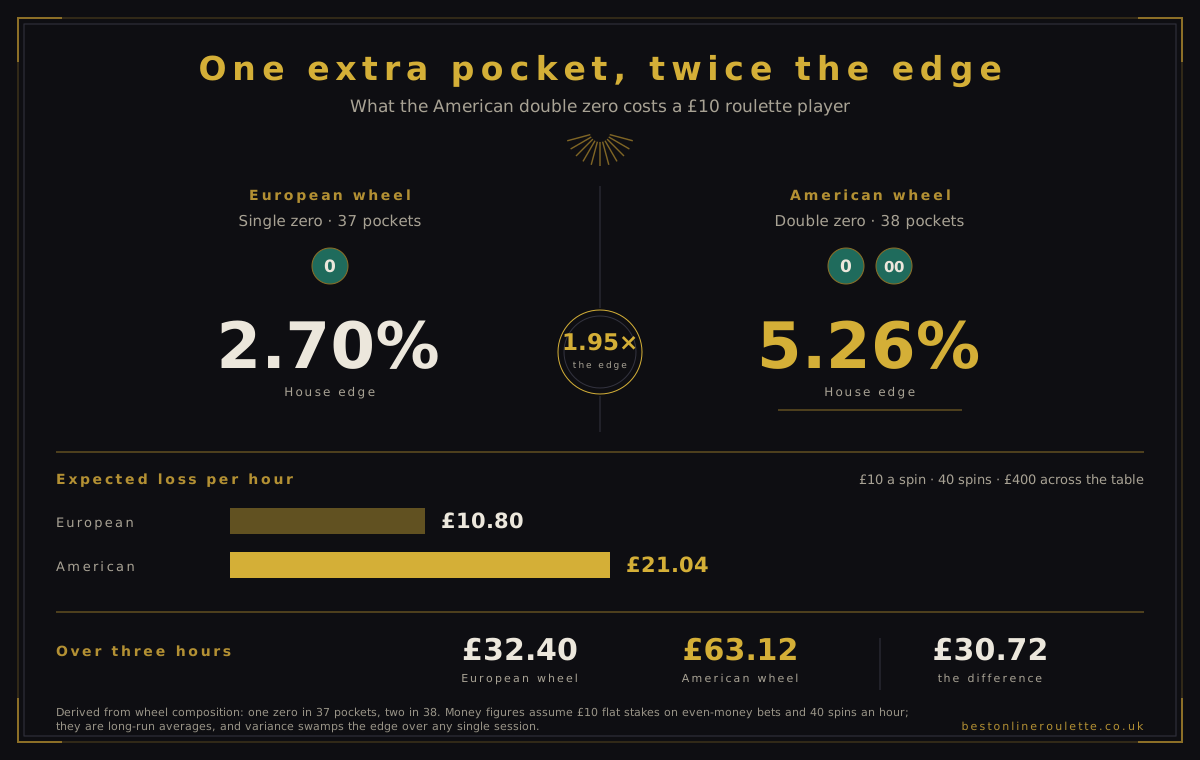
Those figures are averages and no individual evening will match them; variance swamps the edge over any short run, which is exactly why the difference is so easy to miss. It shows up in the aggregate, quietly, over months. The rules and the odds are printed the same way on both tables, and the only visible difference is one extra green pocket.
Why the extra pocket stays invisible while you play
Every figure so far has been a long-run average, and the honest follow-up question is why anyone ever sits at the worse table twice. The answer is that over the length of a real session the two wheels do not produce two different results. They produce two heavily overlapping ranges of results, and a single evening is one draw from whichever range you sat down in front of.
| Spins in a session | European: average return | American: average return | Sessions where the American wheel finished ahead | Overlap of the two ranges |
|---|---|---|---|---|
| 100 | -2.98% | -5.30% | 40.4% | 89.1% |
| 500 | -2.62% | -5.34% | 32.1% | 75.3% |
| 2,000 | -2.69% | -5.26% | 19.9% | 56.3% |
| 10,000 | -2.68% | -5.26% | 3.2% | 19.2% |
The last two columns are the whole answer. Over 100 spins the two ranges share about 89% of their area, and the double-zero wheel comes out ahead of the single-zero one in 40% of paired sessions. Not because it is the better game, it is not and cannot be, but because 2.56 points of difference in expectation is invisible inside a spread of roughly ten points. A player who tried both and trusted the result would reach the wrong conclusion about two evenings in five.
Lengthen the session and the two shapes come apart. By 10,000 spins the American wheel finishes ahead only 3.2% of the time and the overlap has fallen to 19%. That is not an evening. At the forty spins an hour a live table manages it is most of a year of weekly play, which is the horizon over which one green pocket becomes something you could actually notice. It is also the reason this decision has to be taken from the arithmetic rather than from experience: the arithmetic is legible immediately and the experience takes a year to become legible at all.
The two dashed marks are where each wheel is heading: minus 2.70% and minus 5.26% of everything staked. They never move. Only the width of the two humps changes, and at short session lengths that width is what a player experiences instead of the marks.
Which table to actually sit at
Look for French roulette first, then European, and treat American as a table to walk past. In a UK-licensed lobby the single-zero tables usually outnumber the double-zero ones, but the naming is not always helpful: some studios label a single-zero table by its studio brand rather than by its variant, so the pocket count is worth checking on the wheel itself. Which variants each casino actually carries is listed on the ranking of the best online roulette casinos in the UK, counted from the lobbies rather than taken from their marketing.
Checking takes a couple of seconds and settles it regardless of what the table is called. Open the game, look at the wheel graphic before you stake anything, and count the green pockets: one is european roulette, two is American, three is a table to close. On live tables the wheel is on camera the whole time, so the count is there in front of you. On RNG tables the paytable screen lists the pockets, and a straight-up payout quoted at 35 to 1 with a stated probability of 1 in 37 tells you the same thing from the other direction.
One caveat that catches people out. A small number of tables advertise a single zero while quietly paying less than 35 to 1 on a straight-up number, which removes the advantage you came for. Read the payout table alongside the pocket count. Where both look right, the European roulette vs American roulette decision is settled and you can stop thinking about it.
Whether the casino you are playing at runs a deep enough single-zero floor to give you a choice at peak time is a separate question, and one worth answering before you deposit rather than after. That is what the live roulette comparison is for.
Frequently asked questions
Is European roulette always better than American roulette?
For a player, yes, without qualification. The payouts are identical on both wheels and the single-zero wheel has one fewer losing pocket, so every bet on it returns more over time. There is no bet, no system and no circumstance that makes the double-zero wheel the better choice. If both are open, the decision takes no thought.
What is the house edge on each wheel?
The European roulette house edge is 2.70%, from a single zero among 37 pockets. American roulette runs at 5.26% because the double zero makes 38 pockets while the payouts stay the same. French roulette uses the European wheel but the La Partage rule cuts the edge on even-money bets to 1.35%, which is the lowest figure available on any roulette table.
Do the two wheels pay differently on a winning number?
No, and that is exactly why the double zero is so expensive. A straight-up number pays 35 to 1 on both wheels. On the single-zero wheel you are beating 36 to 1 true odds; on the double-zero wheel you are beating 37 to 1 for the same money. The extra pocket is added to the risk without being added to the reward.
What is La Partage and where can I find it?
La Partage returns half your stake on an even-money bet when the ball lands in zero, rather than taking the lot. It applies only to even-money bets such as red, black, odd and even. Look for tables labelled French roulette. Some casinos apply the related En Prison rule instead, which locks the bet for one further spin rather than refunding half.
Are the numbers arranged the same way on both wheels?
No. Both alternate red and black, but the sequences differ. The American wheel places each number directly opposite its consecutive partner, so 1 faces 2. The European sequence is less regular. This affects neighbour and section bets placed on the racetrack, though it changes nothing about the probability of any individual number.
What is the worst bet in roulette?
The five-number bet on the American wheel, covering 0, 00, 1, 2 and 3. It pays 6 to 1 and carries a 7.89% house edge, nearly three times the European roulette house edge and worse than every other bet on either table. It exists only on the double-zero wheel. Avoid it entirely; there is no argument for it.
How much does the difference actually cost over a session?
Flat-betting £5 across roughly 100 spins is £500 through the table in about an hour. The expected loss is £13.50 on a single-zero wheel and £26.30 on a double-zero one. Neither is a prediction of any single session, but over a year of regular play the gap between them compounds into the largest single decision a roulette player makes.
Why do online casinos offer American roulette at all?
Because it earns them close to double per pound staked, and because some players choose it out of familiarity with the American film and television version of a casino. UK-licensed sites generally lead with European and French tables, but the double-zero wheel is usually somewhere in the lobby, often supplied by the same studio that builds the single-zero version for other markets. Dropping it entirely would mean turning away the small number of players who specifically look for it.
Does the difference apply to live dealer tables too?
Yes. The arithmetic is a property of the wheel, not of the software, so a live double-zero table costs exactly as much more as an RNG one does. Most live studios serving the British market run predominantly single-zero wheels, which makes the occasional American table easy to walk into without noticing.
Is European roulette with a poor payout still better?
Check the payout table rather than the name. A handful of tables market themselves on a single zero while paying less than 35 to 1 on a straight-up number, or applying a reduced payout on some outside bets. That erases the advantage. The pocket count and the payout schedule have to be read together, not one or the other.