The weighting, published before the ranking
How We Rate UK Online Roulette Casinos: The Full Scoring Method
Most roulette comparison pages rank casinos and never say why. This one publishes the weighting first, so you can see exactly what was weighed rather than take an order on trust. Six criteria, fixed weights, set before any casino was assessed. The two measured so far are the two the current order runs on, both printed as columns on the ranking table itself rather than folded into a score.
The weighting, in full
The weights are set before scoring and are not adjusted afterwards to produce a preferred order. That sequence matters more than the numbers themselves: a rubric written after the ranking is a justification, not a method.
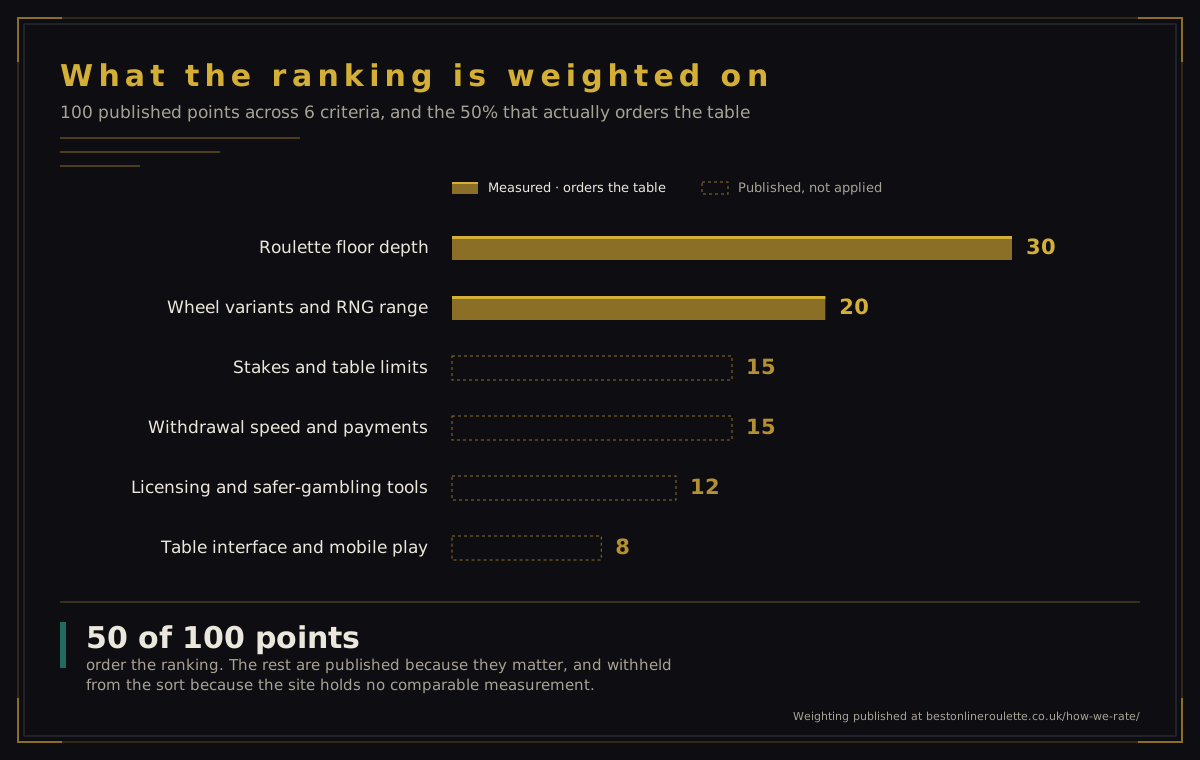
| Criterion | Weight | In the order | What it measures |
|---|---|---|---|
| Roulette floor depth | 30% | Applied | How many distinct roulette games the casino carries and which studios supply them. Counted from the lobby, not taken from a press page, and published on the table itself. |
| Wheel variants and RNG range | 20% | Applied | Whether French roulette with La Partage is offered at all, how many single-zero tables run against double-zero ones, and how deep the software range goes beyond one house wheel. |
| Stakes and table limits | 15% | Not yet measured | The spread between the lowest minimum and the highest maximum. A floor of twenty tables that all take £1 to £200 serves fewer players than eight tables spanning 10p to £5,000. |
| Withdrawal speed and payments | 15% | Not yet measured | Stated processing times, the methods actually available to a British player, and whether withdrawals are reversible after you request them. |
| Licensing and safer-gambling tools | 12% | Not yet measured | A verifiable Gambling Commission remote casino licence, plus the depth of deposit limits, reality checks, time-outs and self-exclusion beyond the licence minimum. |
| Table interface and mobile play | 8% | Not yet measured | Racetrack and neighbour betting, saved bet layouts, and whether the felt is usable one-handed on a phone without mis-taps on the inside numbers. |
Two of the six are switched on, and it is worth being exact about which. Catalogue depth and wheel variants have been counted in each operator's own lobby and published as columns, and between them they carry 50 of the 100 points. The order on the ranking of the best online roulette casinos is those two, weighted in that proportion, and nothing besides, so you can recompute the sequence from the two columns instead of taking it on trust.
The other four are described above and deliberately unapplied. Stake ladders, withdrawal behaviour, safer-gambling tooling and interface quality all have to be checked account by account rather than read off a lobby page, and until that work is done, weighting them would score every casino identically on 50 of the 100 points while implying the opposite. A criterion published without figures behind it is a commitment; one applied without figures is a fabrication.
Why the live floor dominates the weighting
A weight of 30% on one criterion is a deliberate imbalance. Live dealer roulette is both the format most British players choose and the one where licensed casinos genuinely diverge. The RNG side has largely converged: nearly every Gambling-Commission-licensed site carries a competent single-zero wheel, so scoring it heavily would separate almost nobody.
What gets measured is catalogue depth and studio supply, and it is worth being straight about why it is not the number most readers would want. The genuinely useful figure would be how many tables are actually dealing when you sit down on a weekday evening, and nobody can publish that honestly on a page: it changes hour by hour, so any number printed here would be wrong by the time you read it. Depth is the closest measure that stays true. A lobby carrying forty games is worth less than it sounds if half of them sit closed on a Tuesday, and that gap is a real limit of this method rather than something to talk around.
Studio supply is the partial answer to it. A casino taking feeds from more than one provider tends to keep a usable spread of stakes open across an evening, because it is not dependent on a single studio's scheduling. Breadth of supply is checkable from the lobby; concurrency is not.
What the weighting deliberately leaves out
Bonus size is absent, and that is the largest single departure from how these pages are usually built. Roulette typically contributes between nothing and ten per cent toward wagering requirements, so a £500 welcome offer that a roulette player cannot realistically clear is not a benefit worth ranking on. Weighting it would reward marketing spend.
Game count in the round is also excluded. A casino with 3,000 slots and four roulette tables has a large catalogue and a poor roulette floor, and this page has one job. The criterion called Table interface and mobile play carries only 8%, and it is restricted to things that change play: racetrack betting, saved layouts, and whether the inside numbers are tappable on a phone without hitting the wrong one. It is not a mark for how handsome a casino looks, which is a judgement no weighting on this page attempts.
Licence numbers are not published beside operator names here until each one has been read off the Gambling Commission register directly. It would be trivially easy to copy them from another comparison site. Several of those sites carry numbers that are years out of date, which is how you can tell they were copied rather than checked.
Where the underlying data comes from
Licensing is verified against the Gambling Commission public register, which is the only authoritative source and is free for anyone to search. If you want to check a casino yourself before depositing, that register is where to do it, and it takes about thirty seconds.
Game counts, wheel variants and stake limits are read from each casino's own lobby, which is visible without an account at most sites. The figures on the ranking of the best online roulette casinos were taken on 29 July 2026 and every one of them is a floor, written with a plus for that reason. A lobby lists the same game more than once (in a shelf, again in a carousel, again as an image caption), so names are matched case-insensitively and counted once each, and page furniture like Types of roulette bets is discarded rather than counted as a table. Where a lobby loads its catalogue in pages, only what was on screen is counted. That makes each number a reliable minimum rather than a precise inventory: a casino may list more than we saw, but it does not list fewer.
Withdrawal timings lean on published terms more than on repeated first-hand testing, and that is the weakest link in the method rather than a detail to bury. Stated processing time and actual processing time are not the same number, and the gap between them varies by payment method more than by casino. The same caution applies to how many tables are dealing at any one moment: a live floor is busiest on a Friday evening and thinnest on a Tuesday morning, so this page counts what a casino carries rather than what happens to be open when you read it.
No weighting changes the wheel. A single-zero table holds a 2.70% edge at the top-ranked casino and at the bottom-ranked one alike, and the difference between a single and a double zero will cost you far more over a session than the difference between any two casinos on the table.
Frequently asked questions
Do casinos pay to appear higher in the ranking?
No. The order is produced by the two measured criteria on this page, catalogue depth and wheel variants, and by nothing else. Commercial arrangements, where they exist, do not move a casino up or down, and any casino that fails the licensing check is removed from the table entirely rather than ranked last.
Why does the live floor carry almost a third of the weighting?
Because live dealer tables are where UK roulette players spend most of their time, and because it is the criterion casinos differ on most. Almost every licensed site offers a competent RNG European wheel. Far fewer carry a deep live catalogue drawn from several studios, and breadth of supply is the part of that a reader can check from the lobby without opening an account.
Why is the welcome bonus not part of the weighting?
A roulette player benefits from a bonus far less than a slots player does, because roulette usually contributes somewhere between zero and ten per cent toward wagering requirements. Weighting an offer that barely applies to the game this site covers would distort the order in favour of casinos that are simply better at marketing.
How often is the ranking reviewed?
The figures on the table were counted on 29 July 2026, and the licensing check runs against the Gambling Commission public register before any change goes live. Roulette game counts and stake ranges move more often than the order does, so a re-count frequently confirms the existing ranking rather than changing it.
What gets a casino removed from the table?
Losing or surrendering its remote casino licence, withdrawing from the British market, or closing its roulette offering. A regulatory settlement does not automatically remove an operator, but it is weighed under the licensing criterion, and a pattern of them will move a casino down. The table is reviewed on a rolling basis rather than continuously, so a licence change can take a short while to be reflected here after it happens elsewhere.
Are the figures based on real accounts at each casino?
Roulette game counts and wheel variants are checked in the live lobby, which is visible without depositing, and those two are the only figures the order is built from. Stake ladders and withdrawal timings depend on published terms rather than on direct observation, which is precisely why neither one is applied to the order. That is a real limitation of the method rather than something to gloss over.
Does a higher-ranked casino mean better odds?
No, and this is worth being blunt about. The house edge on a single-zero wheel is 2.70% wherever you play it. Ranking affects how good the experience around the wheel is, not the mathematics of the wheel itself, which no casino can change and none of them advertise honestly. A double-zero wheel carries a higher 5.26% edge regardless of which casino hosts it, and no amount of table polish or bonus size changes either number.
Why are there no star ratings or user reviews on this site?
Because there is no genuine pool of user ratings behind them. A five-star badge assembled from nothing is a decoration pretending to be evidence. The weighting on this page is published instead, so you can disagree with a placement and see precisely which criterion you are disagreeing with. Plenty of comparison sites display review counts that were never collected from real players in the first place, and a number with no visible source is not more trustworthy just because it looks familiar.